
Red River Release Date Meaning
A projected date is a forecast based on the sentence and the agency's current time record. It can move. An actual release date records an event that has happened. Red River County jail records, TDCJ records, and court records describe separate parts of that timeline, so one date should not be substituted for another.
A pretrial detainee usually has no sentence-based release date. Release may turn on posting bond, a personal bond, dismissal, a court order, or resolution of a hold. A person serving a county sentence has a judgment, jail-time credit, and jail calculation. A person received into TDCJ may have projected release, maximum sentence, and parole eligibility fields. Each means something different.
The permanent jail register should preserve the release or transfer date. Booking-out forms and release or transfer orders have a minimum retention period of release or transfer plus two years under Texas Local Schedule PS, even when a person is no longer visible online.
Find Red River Projected Release
Begin with the last known custodian. The Red River County Jail and TDCJ use different rules. Federal and immigration systems use still other records. Use an agency number when possible and match the court case rather than choosing a result by name alone.
- Decide whether the person is pretrial, serving a county term, in TDCJ, or held by another authority.
- For county custody, obtain the judgment, sentence-begin facts, jail-time credit, and any release or hold record from the court and Sheriff.
- For state prison, search by TDCJ number or SID; otherwise use name, sex, race, and approximate age.
- Open the TDCJ detail and verify county of conviction, case number, offense, sentence date, and sentence length.
- Record projected release, maximum sentence, parole eligibility, and status as separate fields.
- Ask the holding agency to confirm the current calculation and any scheduled event.
The Red River County release search helps identify the correct system before a date inquiry. A county booking closed by “TDCJ pickup” marks transfer into state custody, not community release.
TDCJ Red River Release Fields
The TDCJ offender search is relevant only after TDCJ receives a person or when the person served a state sentence. It is not an archive of county-only jail stays. The strongest searches use a TDCJ or SID number. Detail fields can vary by record.
| TDCJ field | How to read it |
|---|---|
| Projected Release Date | TDCJ's current estimate under the sentence and time record. |
| Maximum Sentence Date | The calculated sentence endpoint, not a promise of physical release that day. |
| Parole Eligibility Date | The point at which review may occur, not approval or a release order. |
| Parole Review Information | The Board's review or vote stage, which may include conditions. |
| Scheduled Release Date | A later processing date that can still change before departure. |
| Status or release information | The field to read for evidence of an actual release or discharge. |
TDCJ offender information provides telephone and email alternatives when a historic result is thin or a status is unclear. Keep the TDCJ or SID number with the inquiry.
The official offender-search interface shows where the lookup begins.
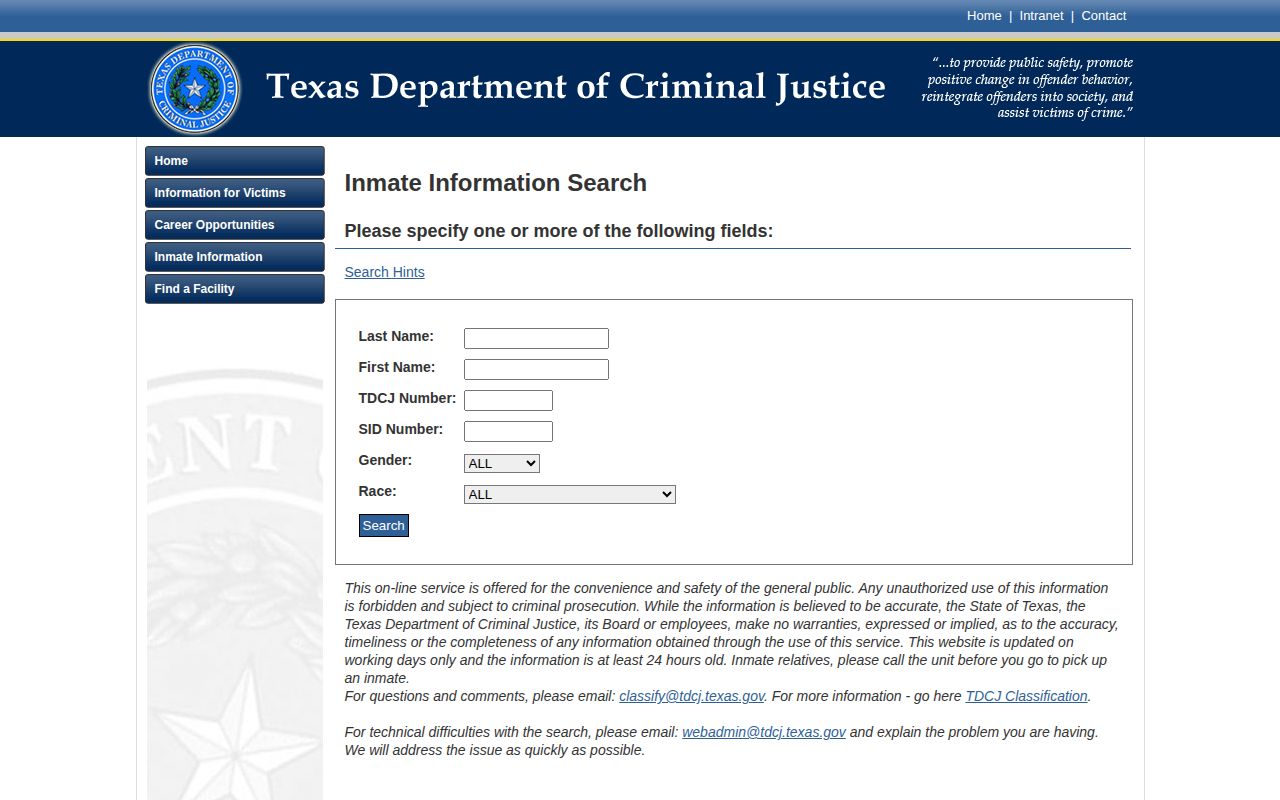
The form supports identity matching; the selected detail supplies the distinct sentence and release labels.
Texas Good Time Release Rules
Texas Government Code Chapter 498 governs TDCJ good-conduct time. Good time is a privilege that can affect authorized eligibility calculations. It does not reduce the sentence imposed by the judge. Classification, accrual, forfeiture after discipline, and possible restoration can change the time record.
Parole and mandatory supervision fall under Government Code Chapter 508. Section 508.145 ties eligibility to the offense date, offense, sentence, calendar time, and qualifying credits. Section 508.149 restricts mandatory supervision for specified people and offenses. Older cases may be controlled by earlier law, so a general formula cannot replace TDCJ's calculation.
- Good-conduct time
- An agency credit used in authorized calculations, subject to forfeiture; it does not rewrite the court's sentence.
- Parole eligibility
- The date a case may be considered for conditional release, not a grant.
- Mandatory supervision
- A statutory release form with supervision, limited by eligibility rules.
- Detainer
- A notice that another authority may take custody or require a hold.
Note: The offense date and judgment control which version of Texas law applies to a named state sentence.
No Universal Texas 85%
Texas does not have a blanket rule that every state or county prisoner serves 85 percent. For specified serious offenses, Texas parole law can require actual calendar time equal to one-half of the sentence or 30 years, whichever is less, subject to a statutory minimum. Good-conduct time does not move that threshold forward. That is not the same as 85 percent.
The familiar approximate 85-percent figure comes from a federal good-time regime for eligible federal sentences. It cannot be imported into a Red River County jail calculation or a TDCJ sentence. Even within Texas, offense category, offense date, deadly-weapon findings, consecutive terms, and mandatory-supervision limits can change the analysis.
Use the current Texas statutes, the judgment, and TDCJ's named-person calculation. A rough percentage is not a release date.
Red River Release Date Changes
Several events can move or block a projection. Some alter the time record. Others leave the calculation intact but prevent a person from leaving to the community.
| Factor | Possible effect | Best source |
|---|---|---|
| Jail-time credit correction | Changes credited calendar time. | Judgment, court order, TDCJ record |
| Good-time forfeiture or restoration | Changes an authorized eligibility calculation. | TDCJ classification and time record |
| New or consecutive sentence | Adds time or changes sentence order. | Court judgment and TDCJ detail |
| Detainer or agency hold | May cause transfer rather than community release. | Jail or TDCJ release record |
| Parole vote | May deny, defer, or condition release. | Board result and TDCJ status |
| Required program | Can delay release until completion and approval. | Board vote code and Parole Division |
| Court action or recalculation | Can move a scheduled or maximum date. | Court and agency records |
A projected date can also change on the date itself. Confirm before arranging transportation or assuming the person has left custody.
Red River Parole Processing
A favorable Board of Pardons and Paroles vote starts another process. It does not certify release. The Board uses codes such as FI and RMS, some of which require a future date, transfer, treatment, or program completion. New disciplinary, case, or protest information can cause reconsideration.
After Classification and Records receives a release certificate, TDCJ audits the case and calculates a scheduled date. The TDCJ Ombudsman says this commonly takes about 14 to 21 business days. A case tied to program completion can take roughly four to six weeks, depending on required information and an approved residence. Those are processing ranges, not guarantees.
Certainty rises in steps: parole eligibility permits review; an FI or RMS result records a conditional decision; a scheduled release date reflects later processing; an actual release or discharge entry records departure. If the vote is favorable but release is not shown, use the Parole Division release-status channel rather than saying the person is already out.
Red River County Formula Limits
No official Red River County weekend-release formula or local good-time policy was found. TDCJ's projection belongs to a state sentence and cannot be copied onto a county jail term. The local calculation must come from the judgment, sentence start, jail-time credits, lawful county practice, other holds, and the Sheriff's existing time or release record.
Ask the Sheriff for the calculation or record maintained for the named custody episode. Ask the clerk for the filed judgment and any later credit or release order. If the record uses a code, seek the existing code legend. The Public Information Act does not require the county to create a fresh calculation or answer a legal question.
For pending notice after a date is confirmed, the Red River County VINELink check explains the current IVSS registration route. An alert is still a lead, not the final release document.
Red River Custody Holds
Other holds are part of the local inquiry. A county sentence may be complete while a warrant, federal writ, immigration detainer, or another county's process causes a custodial handoff. Request the receiving agency and destination with the date. Without those fields, a projected exit from the county jail can be mistaken for return to the community.
Public Record Search
Sponsored Results